How to teach a dog to stay is less about the word and more about teaching your dog that holding position pays off — even when you walk away, even when the world is distracting. Dog commands don't get more practical than this one.
Key Takeaways
How to teach a dog to stay — build duration before distance before distractions.
Dog training tips: release the stay with a clear cue every time to avoid confusion.
Start with one second, reward, and build gradually — patience is the whole game.
Dog commands like stay work best when paired with a solid foundation in “sit” and “down”.
Real-life applications like doorways and mealtimes are where stay truly shines.
How to Teach a Dog to Stay in 4 Simple Steps
The foundation of how to teach a dog stay is simple: ask for a position, reward stillness, release clearly.
Step 1: Ask for a position
Start with “sit” or how to teach a dog to lay down and stay — either works. The position must be solid before adding stay.
Step 2: Mark and reward stillness
The moment your dog is still, say “yes” and treat. Don't wait for them to break — reward immediately in the first sessions.
Step 3: Add your stay cue
Once your dog holds for a second, add the word “stay” as you give the hand signal. Palm facing your dog is the most common signal.
Step 4: Release every time
Use a clear release word like “okay” or “free.” Without it, your dog is left guessing. Dog training without a clear release creates anxious, unreliable stays.
💡 Tip
Never call your dog out of a stay — always go back to them to release. This builds a rock-solid stay that holds even when you're across the room.
Adding Duration, Distance, and Distractions
Once your dog holds a brief stay, you start making it harder — on purpose, but in a careful order. Dog training tips for stay center on the 3 Ds, and that order matters as much as the list itself:
Duration — how long your dog holds the position. Build this first, standing right next to them.
Distance — how far you can step away. Add it only once duration is solid.
Distractions — noise, people, and other dogs. Introduce these last, one at a time.
The most common mistake is rushing to distance before duration is solid. If your dog can't hold a ten-second stay with you standing right beside them, walking across the room will break it every time. Like most commands to teach your dog, stay rewards patience — add just one D at a time, and only once the last one holds.
Dogs don't generalize well — a stay learned indoors needs to be retaught outdoors. Always proof stays in new environments before relying on them.
Want the 3 Ds built in the right order, without the guesswork?
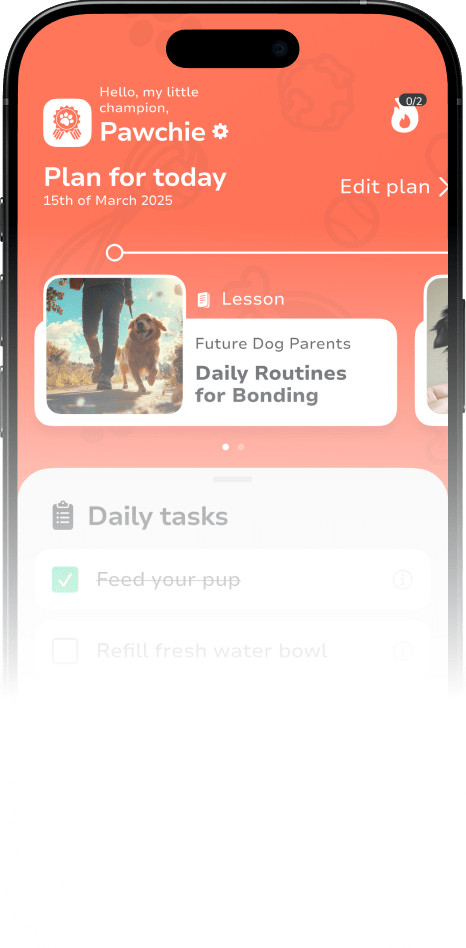
Answer a few quick questions and PawChamp maps a personalized stay-training plan for your dog's level.
Using Hand Signals to Reinforce the Stay Command
As distance grows, your voice carries less — which is exactly where hand signals earn their keep. Hand signals for dogs are powerful in noisy places or at a distance. The classic stay signal is an open palm facing your dog, like a “stop” gesture — use it every single time you say “stay.”
A dog commands chart that includes both verbal and visual cues helps owners and all household members stay consistent. Agree on your cues and stick to them — common dog commands only work when used consistently by everyone.
💭 Think about
What real-life situation would a reliable stay help most in your life? Train specifically for that scenario once your dog's stay is solid in neutral environments.
Teaching Stay for Real-Life Situations
This is where all that careful groundwork finally pays off. How to teach a dog to stay off the couch? Teach a “place” command — a mat or bed — as the alternative, and reward it generously. Consistency is everything: if “stay off” sometimes still leads to couch access, your dog quickly learns that persistence pays.
Dog training commands for real life only stick when you proof them in the exact environments where you'll use them. Start without the real trigger, then introduce it gradually as your dog succeeds.
That's also why how to train reactive dogs so often leans on stay as a core management tool: a dog who can hold a reliable stay when something sets him off has more impulse control — and is far easier to guide calmly through the moment.
How PawChamp Helps?
Here's the truth this whole guide keeps circling back to: teaching the word “stay” is easy — building a stay your dog actually holds, across duration, distance, and distractions, is what takes weeks of small, consistent reps. That daily structure is exactly what PawChamp is built to carry.
Step-by-step exercises that follow the 3 Ds in the right order — duration before distance before distractions — so you build a stay that doesn't collapse the moment you add difficulty.
Progress tracking that shows you exactly when a stay is solid enough to add distance, a distraction, or a brand-new environment.
Daily streaks and short sessions that keep practice consistent, because a reliable stay is built on frequent reps, not one long weekly attempt.
Ask a Dog Expert for the moment your dog breaks the stay and you're not sure whether to slow down or push on.
And because dogs don't generalize, the same stay has to be re-proofed in every new place — exactly where a guided plan beats guesswork. PawChamp turns “I taught it once” into “my dog holds it anywhere.”
Bottom Line
How to teach a dog to stay takes patience, consistency, and a willingness to build slowly. Once your dog has a reliable dog stay command, everyday life gets genuinely easier. Start small, reward generously, and release clearly every time.